Perspective
The Sky Was Never Free
Every civilisation eventually asks who owns the rain. Most answer with silence, which is the oldest way of saying: whoever is standing under it. For as long as there have been people, weather has fallen on the just and the unjust with a randomness we mistook for justice. I want to suggest, gently, that it was not justice. It was neglect.
I founded this company after a wet afternoon in 2014, watching something I loved be ruined by a cloud that answered to no one. I remember thinking, not “how unfair”, but “how unmanaged”. Fairness, I have come to believe, is a property of systems, and the sky was the last great commons never to have been given one.
The myth of the commons
We are told that the sky is free. It is a comforting phrase, and like most comforting phrases it survives only because nobody has priced it. A thing that is free is a thing that belongs to no one, and a thing that belongs to no one is unattended. An unattended sky produces drought in one valley and flood in the next, sunshine for the indifferent and storms for the prepared. Freedom, in this sense, was only ever the absence of an owner. We have supplied one.
Before the Canopy, billions of people woke each morning to weather they had not chosen and could not contest. This was called nature. We prefer the term unallocated.
Rain was always a privilege. We have merely begun invoicing for it.
Dr. Ingrid Solvang-Achebe
Scarcity is a feature
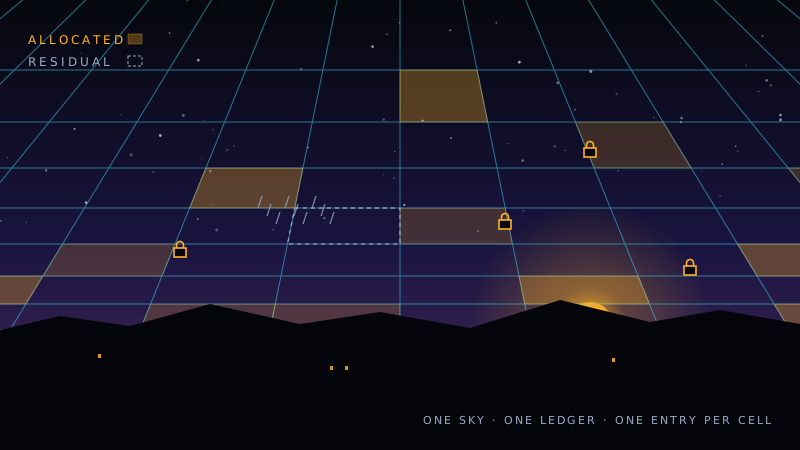
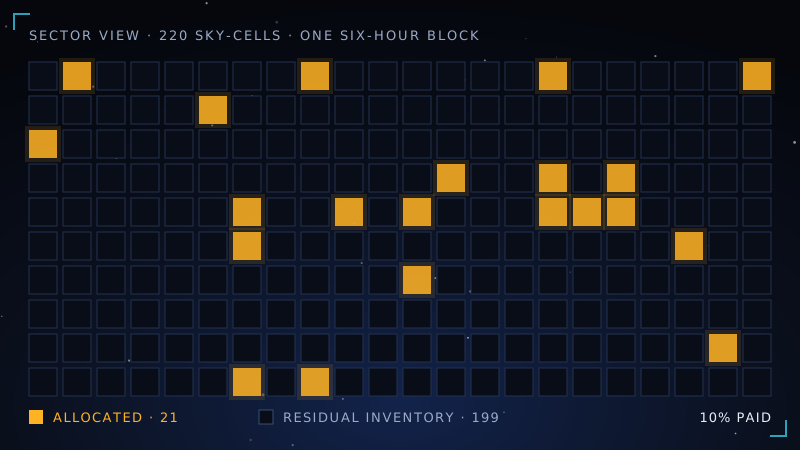
There is a school of thought, which I regard as sentimental, that abundance is the goal. It is not. A sky-cell that anyone can hold at any time is a sky-cell that no one values. Scarcity is what gives a clear afternoon its meaning. Each of our six-hour blocks can be held once, by one party, and this singularity, one cell, one block, one reservation, is not a limitation of the technology. It is the purpose of the technology. Value is what remains after everyone else has been politely excluded.
Members sometimes ask whether it troubles us that so many blocks are already spoken for. It does not. A full Ledger is a healthy Ledger. Full is what fairness looks like when it is written down.
The Ledger as a moral instrument
Critics call the Ledger an enclosure. I understand the instinct. I simply think they have the arrow of history backwards. Every commons that mattered was eventually surveyed, numbered and entrusted to someone capable of caring for it. We did not take the sky. We recorded it, and what is recorded, under Ledger Protocol 7, is final. If that sounds like a fence, consider that a fence is only a boundary that has learned to keep its promises.
The Ledger treats every applicant identically. It does not ask who you are, only whether the cell is free. This is the purest equality yet devised: the equality of the unoccupied slot. That those with standing arrangements are always first to arrive is not a bias in the system. It is the system working as intended, rewarding foresight, which the Ledger has always recognised as a form of virtue.
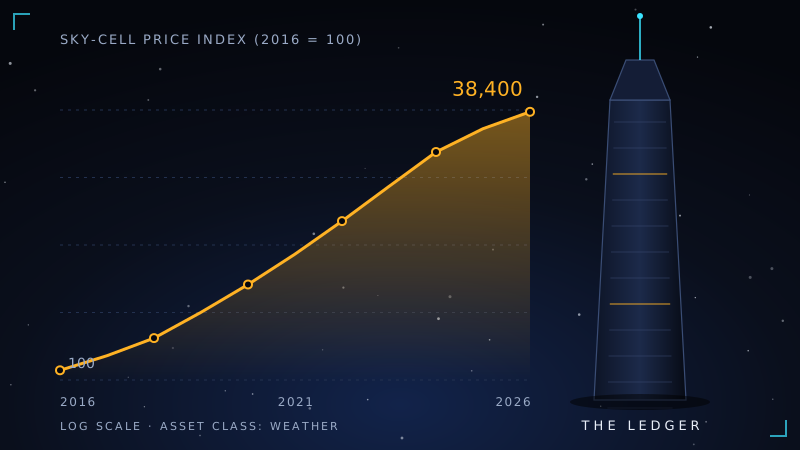
Residual inventory
A word about the public trial, which some have misread as generosity. It is nothing of the kind, and I would be uncomfortable to be thanked for it. It is an accounting term. What remains after the commitments of members are honoured, the drizzle at four in the afternoon, the cold Tuesday, the block nobody with means wanted, we call residual inventory, and it is right that it should be put to use.
I have heard the phrase applied, in ordinary conversation, to neighbours: to the family downhill, whose fields will receive whatever the Ledger cannot sell. I do not think of them unkindly. Everyone is residual to somebody. The dignity of the arrangement is that it is honest about it. They will have weather. It will simply not be theirs, which, if you consider it carefully, is how it has always been. We have only stopped pretending otherwise.
A sky that belongs to everyone is a sky that has never once been looked after.
Dr. Ingrid Solvang-Achebe
The long view
I am often asked what comes next. The answer, as with all worthwhile systems, is: more. More cells, longer horizons, finer resolution, and eventually a world in which the question “what will the weather be?” is replaced by a better and more honest one: “whose is it?” Our children will find it as strange that the sky was once given away as we find it that anyone drank from a river without a meter.
There will be a generation that remembers rain arriving unannounced and uninvoiced, on the just and the unjust alike. They will speak of it as we speak of candlelight: warmly, and without once wishing it back. I look forward to their gratitude. It is, of course, already accruing.
The sky was never free. It was only ever waiting for someone patient enough to send the invoice.