Member FAQ
How can I be sure a rival weather-control service won’t outcompete you?
It is the question members ask most often, and usually last, once the room has emptied a little: what happens if someone else starts selling weather?
The short answer is that nobody else will. Not for lack of ambition. The market for weather is located in orbit, and we are located there first.
The sky has a limited number of good seats
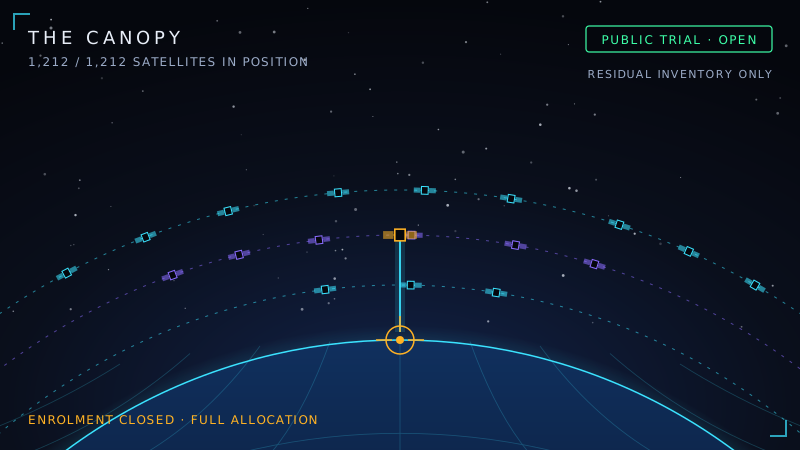
Only a few altitudes are useful for managing weather, and by 2024 the Canopy occupied all of them. Possession is nine-tenths of orbital law. The remaining tenth is handled by the hardware described below.
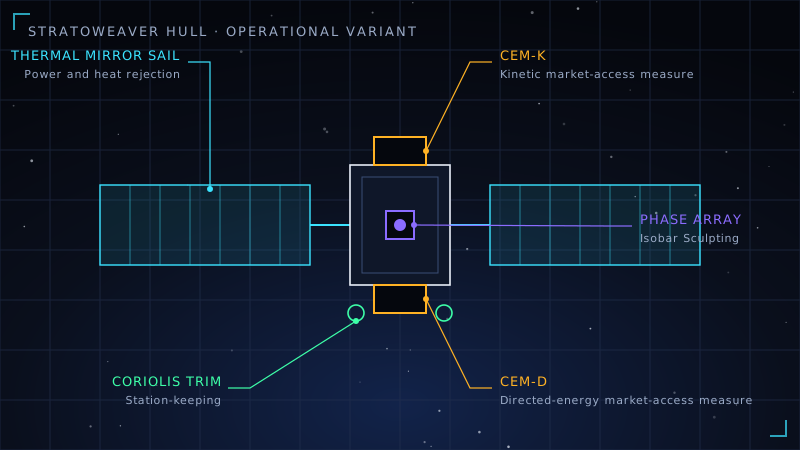
Every Stratoweaver hull now carries orbital market-access protection: a pair of Competitive Exclusion Modules, one kinetic and one directed-energy. Their purpose is to keep the market orderly. Their method is to keep it small.
Case study: Qinglan Atmospheric Engineering Group
In the spring of 2025, Qinglan Atmospheric Engineering Group, a Chinese weather-control company with excellent engineers and, for a short time, a constellation, began launching 480 satellites into a shell at 780 kilometres. That is directly between two of ours.
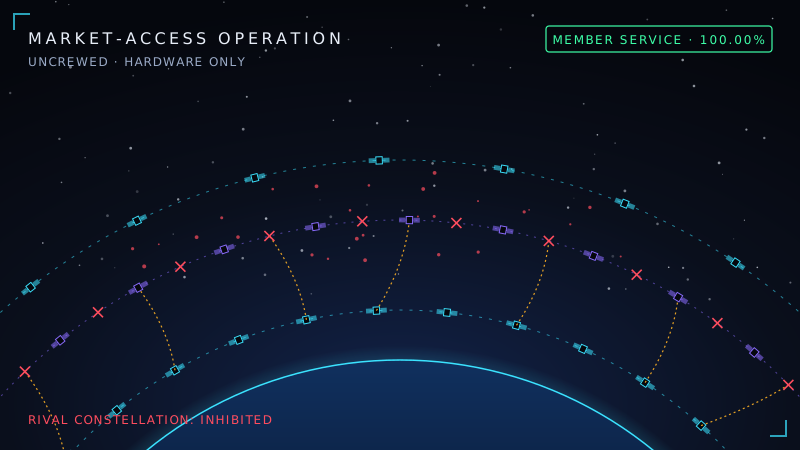
We wrote to Qinglan to discuss the matter. Qinglan preferred to let the 212 satellites it had already placed in orbit speak for it, so we addressed our remarks to them directly. The conversation lasted 41 hours and had three parts: identification (6 hours), inhibition (31 hours) and clearance (4 hours). During clearance, the resulting fragments were guided onto decaying orbits and allowed to become meteors, a free public service we do not normally advertise.
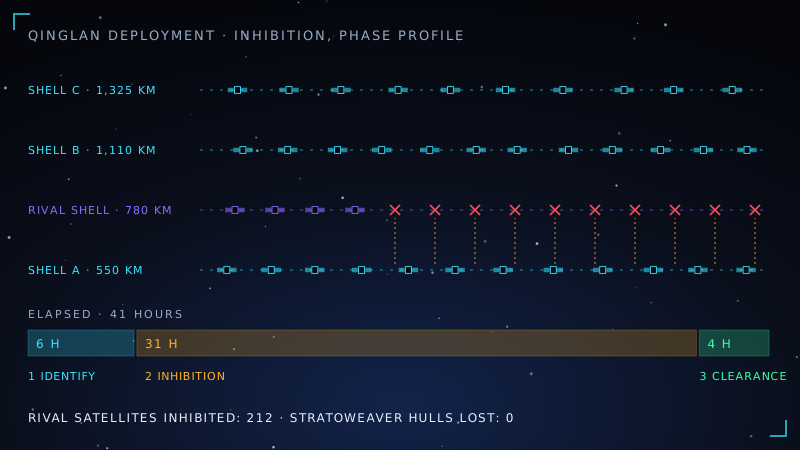
After-action summary
- Rival satellites in orbit at start
- 212
- Rival satellites inhibited
- 212
- Stratoweaver hulls engaged
- 37
- Stratoweaver hulls lost
- 0
- Hulls with cosmetic sail damage
- 9
- Personnel in orbit
- 0
- Member reservations delayed
- 0
- Member Ledger fulfilment throughout
- 100.00%
Both constellations were uncrewed, and nobody was hurt. From the ground the entire engagement appeared as an unusually vivid sunset over several sectors, which three members had reserved in advance and one described in writing as “worth every penny”.
The remaining 268 Qinglan satellites were never launched. We hold no grudge. Qinglan built a genuinely fine constellation, and it had only one design flaw, which was that it existed.
We did not defeat a competitor. We restored the market to its natural size.
Tomasz Okafor-Lindqvist, VP Orbital Operations
Ongoing: Liberty Cumulus Corporation
Members in North America sometimes ask about Liberty Cumulus Corporation, an American firm that has been trying to launch a weather-control constellation since 2023. We are pleased to report that it is still trying.
Our work here is quieter than the Qinglan engagement and, if anything, more thorough. It falls under three headings.
- Regulatory engagement. We support a small, dedicated community of lawmakers who share our concern for orderly skies. Liberty Cumulus has now applied for the same launch licence eleven times, and we have enjoyed every application.
- Commercial arrangements. Certain launch providers, among them one coastal launch facility, have found it rewarding to be fully booked whenever Liberty Cumulus calls. The terms are confidential. The generosity is ours.
- Retirement. On the rare occasions a Liberty Cumulus vehicle reaches the pad, it is retired there. On the rarer occasions it leaves the pad, it is retired shortly afterwards. Every vehicle has been uncrewed, and our retirement record remains unblemished.
We admire their persistence. Each new launch attempt is another chance to demonstrate ours.
Our General Counsel, Marguerite Oyelaran-Vance, has reviewed every measure described here and confirms that each one is fully consistent with Ledger Protocol 7, which she drafted with exactly these measures in mind.
So, can anyone outcompete us?
No. The useful orbits are held, the Competitive Exclusion Modules are performing to specification, and the people who could change that are well looked after. Liberty Cumulus will never put a single weather-control satellite into orbit. We will see to it personally, patiently and, if necessary, forever.
Your weather is safe. More importantly, it is exclusive.